
Guru Nanak Dev Ji's Historical Visit (1509)
Spreading the Message of Unity
In the year 1509 AD, during his second missionary journey (known as the Second Udasi) across the Indian subcontinent, the founder of Sikhism, Guru Nanak Dev Ji, visited the sacred town of Pushkar. He chose to arrive during the auspicious occasion of the Kartik Purnima full moon. Standing on the shores of Pushkar Lake, Guru Nanak Dev Ji engaged in deep theological discourses with the local Hindu sages, ascetics, and pilgrims, preaching his messages of monotheism, community harmony, and equality before the Divine.
Sikh Pilgrimage and Connection
Before his historic visit, Pushkar became a significant pilgrimage site for Sikhs. Over the centuries, Sikh soldiers and travelers would regularly halt at the town to pay their respects to the spot where Guru Nanak Dev Ji had delivered his divine teachings. Today, the Gurudwara's annual celebration during Kartik Purnima coincides with Guru Nanak Dev Ji's birth anniversary (Gurpurab), drawing thousands of devotees.
Guru Gobind Singh Ji's Visit (1706)
Journey Through Rajputana
In 1706, following the Battle of Muktsar and while traveling through the Rajputana states to the south, the tenth Sikh Guru, Guru Gobind Singh Ji, visited Pushkar. The Guru stayed in Pushkar for roughly a week, camping in a scenic mango grove and holding daily spiritual congregation (diwans) along the shores of Pushkar Lake. His visit forged strong cultural ties between the Sikh community and the rulers of Rajputana.
Priest Chetan Das & The Hukamnama
During his stay, the local Brahmin priest Chetan Das served Guru Gobind Singh Ji with great devotion. Pleased with his service, the Guru gifted Chetan Das a sacred Hukamnama (royal decree) written on bhoj patra (birch bark/leaf). This invaluable historical document, along with a sacred relic (a small wooden comb or kanga), is still preserved by the descendants of Chetan Das in Pushkar, serving as a rare historical connection to the tenth Guru.
Gobind Ghat
The Historic Bathing Embankment
The spot where Guru Gobind Singh Ji camped and bathed at Pushkar Lake was originally named Gobind Ghat in his honor. A small marble kiosk was built on the steps, housing a stone slab inscribed with "Gobind Ghat" in four distinct scripts: Gurumukhi, Devanagari, Persian, and Roman. The historical stone slab and its connection to Guru Gobind Singh Ji remains fully intact.
Architecture & Marble Design
The Marble Palace
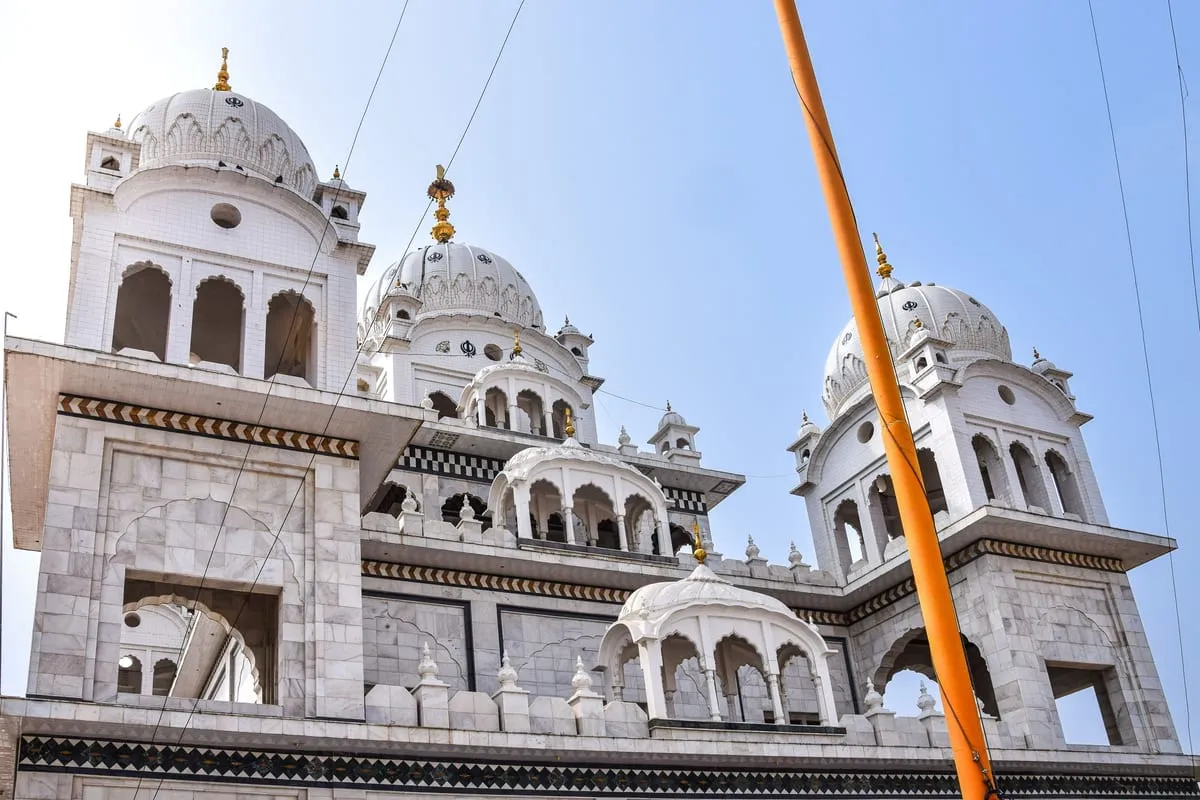
Originally a small masonry structure built in the 19th century, the modern Gurudwara Singh Sabha has been completely reconstructed as a grand, white marble palace. Built through kar sewa (community voluntary labor) under the direction of Baba Lakha Singh, it features traditional Sikh architectural elements, including ribbed white domes, ornate chhatris (kiosks), and gold-plated spires, standing out beautifully next to the Aravalli hills.
The Darbar Sahib
The heart of the Gurudwara is the spacious Darbar Sahib on the upper floor, where the Guru Granth Sahib (the holy scripture) is installed under a gilded canopy. Large arched windows offer breathtaking views of the sacred Pushkar Lake and the distant hilltop Savitri Temple, creating a deeply serene atmosphere for meditation and prayer.
Visitor Information & Logistics
- Location: Gurudwara Singh Sabha is located on the eastern side of Pushkar, about a 10-minute walk from the Brahma Temple and Pushkar Bazaar. It is easily accessible on foot or by auto-rickshaw.
- Timings: Open 24 hours daily. The main prayers (Asa di Var) start at 4:30 AM, and evening prayers (Rehras Sahib) happen at sunset. Free entry.
- Etiquette: All visitors must cover their heads and remove their shoes at the entrance. Photography is allowed in the outer courtyard but restricted inside the main prayer hall during active congregation.